
If you have been told you may need a cornea transplant, it is completely natural to feel nervous. The idea of surgery on your eye, with tissue from a donor, raises a lot of worries, about pain, about whether it will work, about recovery, and about whether you will see again. This page is written to answer those worries honestly, one by one, alongside clear information about what the operation is and what to expect. The aim is simple: so that by the end you understand the procedure well enough to feel calm and in control of your decision.
The reassuring starting point is this. A cornea transplant is one of the most common and most successful transplant operations performed anywhere in the world. It has been done for over a hundred years, the techniques are well established, and for most people it restores clear, usable sight that was slipping away. It replaces only the thin front window of the eye, not the whole eye, and it does not involve removing or “swapping” your eye in any way.
“Is a cornea transplant a major, dangerous operation?”
It is a well-established, routine procedure for eye surgeons, usually taking under an hour, often done under local anaesthesia so you can go home the same day or after a short stay. Only the damaged front layer of the cornea is replaced. Serious complications are uncommon, and the operation has a strong track record of restoring sight.
Quick answer A cornea transplant, also called keratoplasty, is an operation that removes a damaged or diseased cornea, the clear front window of the eye, and replaces it with healthy clear tissue donated by another person. The new cornea lets light pass cleanly into the eye again, which can restore vision, relieve pain from a damaged cornea, and in some cases save an eye that would otherwise be lost. |

To understand the operation, it helps to know what the cornea is. The cornea is the transparent, dome-shaped layer at the very front of the eye, the clear part you would touch if you touched your eyeball. It has two main jobs. First, it is the eye’s main focusing lens, bending incoming light so it lands sharply on the retina at the back of the eye and does most of the eye’s focusing work. Second, it acts as a protective barrier against dust, germs and injury. For vision to be clear, the cornea has to stay transparent and keep a smooth, even curve.
When disease, injury or infection makes the cornea cloudy, scarred, swollen or badly misshapen, light can no longer pass through it cleanly, and vision drops, sometimes severely. If glasses, contact lenses, medicines and other treatments can no longer help, replacing the damaged cornea with a healthy donor cornea is often the way to restore sight. That replacement is the cornea transplant.
One point that reassures many patients: the cornea has no blood vessels of its own. It is nourished by tears on the outside and by the clear fluid inside the eye. This matters for a transplant, because it is part of why the body is far less likely to reject a donated cornea than it is to reject a donated organ like a kidney or heart. We come back to this in the section on rejection below.
Quick answer
A cornea transplant is needed when the cornea becomes too cloudy, scarred, thinned or misshapen for vision to be corrected any other way, or when a damaged cornea causes pain or infection that will not settle. Common reasons include advanced keratoconus, corneal scarring, corneal swelling (bullous keratopathy), Fuchs’ dystrophy, severe infections or ulcers, injury, and a previous transplant that has failed.

A transplant is not a first step. It is considered only when the cornea is damaged enough that clearer, simpler options cannot restore useful sight or control a problem. Knowing the reasons it is done helps answer a worry many people have, whether their eye is “too far gone” to help. In most cases it is not. The common reasons a cornea transplant is recommended are:
Quick answer There are two broad approaches. A full-thickness transplant (penetrating keratoplasty, or PKP) replaces all layers of the central cornea. A partial-thickness transplant replaces only the damaged layer, either the front layers (DALK) or the thin back layer (DSEK or DMEK). Replacing only the damaged layer usually means faster healing and lower rejection risk. Your surgeon chooses the type based on which layer of your cornea is affected. |

Modern cornea surgery is increasingly about replacing only the layer that is actually damaged, rather than the whole thickness. This is gentler on the eye, heals faster, and lowers the chance of rejection. Which type is right depends entirely on which part of your cornea is diseased, something your surgeon works out from examination and scans.
Full-thickness transplant (Penetrating Keratoplasty, PKP)
In penetrating keratoplasty, the surgeon removes a small round disc through the full thickness of the central cornea and replaces it with a matching full-thickness disc of donor cornea, stitched into place with very fine sutures. It is the traditional and most complete form of transplant, and it is used when damage runs through all the layers of the cornea, for example deep scarring or an advanced cone. Because it involves all layers and multiple stitches, healing and vision recovery are slower than with the partial techniques, and the stitches stay in for many months.
Front-layer transplant (Deep Anterior Lamellar Keratoplasty, DALK)
DALK replaces the front and middle layers of the cornea while keeping your own healthy innermost layer (the endothelium) in place. It suits conditions that affect the outer layers but spare the inner pump cells, such as keratoconus and front-surface scars. Because your own inner layer is preserved, the risk of the most serious kind of rejection is much lower than with a full-thickness transplant, which is a real advantage for younger patients who will live with the graft for decades.
Back-layer transplants (Endothelial Keratoplasty: DSEK and DMEK)
These replace only the thin innermost layer of the cornea, the endothelium, which is the pump that keeps the cornea clear and dry. They are used when the problem is swelling from failing pump cells, as in Fuchs’ dystrophy and bullous keratopathy. In DSEK (also written DSAEK), a thin layer of donor tissue is placed inside the eye; in DMEK, an even thinner, more delicate layer is used. A small air or gas bubble is placed in the eye to hold the new layer against the back of the cornea while it settles, which is why you may be asked to lie on your back for a while after surgery. These techniques often give quicker visual recovery, need few or no surface stitches, and carry a lower rejection risk.
Artificial cornea (Keratoprosthesis)
When a donor transplant is unlikely to succeed, for example after repeated graft failures or certain severe injuries, an artificial cornea made of clear plastic can sometimes be used instead of donor tissue. It is reserved for difficult cases and is used less often than donor transplants, but it means that even some eyes that have run out of standard options can still have a chance of sight.
For most people, fear of pain is the single biggest worry about eye surgery, and the thought of being awake while it happens can be frightening. Here is what actually happens.
Risk of rejection varies based on the surgical technique used and the condition of the eye. For example, in the case of DSEK, it could vary between 12 to 20 percent. While in case of DMEK, the rate of rejection can be as low as 1 percent. Chance of rejection increases with conditions such as dry eye, blood vessels growing in the cornea, and eye infections
Some the other key risks/ complications of cornea transplant surgery include the following:
“Will I feel the surgery? Will it be painful?” No. The eye is completely numbed before the operation, so you do not feel pain during the surgery. The procedure is done either under local anaesthesia (numbing injections or drops around the eye, with medicine to keep you relaxed) or under general anaesthesia (fully asleep). With local anaesthesia you may be aware of light and gentle pressure, but not pain, and you do not “watch” the operation or see instruments coming toward your eye. |
“How much will it hurt afterwards?” Most people feel only mild discomfort once the numbness wears off, often described as grittiness, watering, light sensitivity, or a feeling that something is in the eye, rather than real pain. This is normal and settles over the first days. Your surgeon gives you eye drops and, if needed, simple pain tablets to keep you comfortable. Severe pain is not expected, so if it ever occurs it is a signal to contact the clinic promptly. |
Choosing between local and general anaesthesia is something your surgeon and anaesthetist decide with you, based on your health, your anxiety level, the type of transplant, and how long it is likely to take. If being awake worries you, say so, it can be taken into account.
Quick answer On the day, your eye is numbed, the damaged cornea (or the damaged layer) is carefully removed, and healthy donor tissue is placed and secured, either with very fine stitches or, for back-layer transplants, with an air bubble. The operation usually takes around 45 minutes to an hour, and in many cases you go home the same day or after a short stay. |

Knowing the sequence removes a lot of the fear of the unknown. While the exact steps depend on the type of transplant, the overall journey looks like this:
Afterwards you rest for a short while and, in most cases, go home the same day or after a brief stay. You will not be able to drive yourself home, so arrange for someone to take you. Your eye stays covered with a shield at first, especially at night, to protect it while it begins to heal.
This is the deepest fear for most people, and it deserves a straight answer rather than reassurance alone.
“Could the transplant fail, or could I go blind from the surgery?” Serious, sight-threatening complications are uncommon. A cornea transplant has a strong record of success, and in the great majority of people it improves or restores sight. If a graft does cloud over or fail later, it is usually not the end of the road, a cornea transplant can, in most cases, be repeated with fresh donor tissue. Total loss of the eye from the surgery itself is rare. |
Being honest also means naming the possible complications, so you can recognise them early, because almost all of them are treatable when caught quickly. They include graft rejection (covered in detail below), infection, raised pressure inside the eye, problems with the stitches, and the graft not staying clear. This is exactly why the follow-up appointments after surgery matter so much: they let your surgeon spot and treat any issue early, usually with eye drops, long before it threatens your sight. Attending every follow-up is the single most powerful thing you can do to protect the result.
When to get help urgently after surgery Contact your eye surgeon straight away if you notice any of the warning signs that spell the word RSVP: Redness, Sensitivity to light, Vision getting worse, or Pain. These can be the first signs of rejection or another problem, and acting early gives the best chance of fixing it. |
Disclaimer: All information, provided above is for informational purposes only and is not intended to serve as a substitute for the consultation, diagnosis, and/or medical treatment of a qualified physician or healthcare provider. Read our full disclaimer here.
Quick answer Rejection is far less common with a cornea than with organ transplants, because the cornea has no blood vessels, so the body’s immune system is much less likely to attack it. If rejection does begin, it can usually be stopped with eye drops when it is caught early, which is why you are taught the warning signs and kept on follow-up. Most patients use anti-rejection eye drops rather than the heavy lifelong medicines that organ-transplant patients need. |

The word “rejection” understandably frightens people, because they picture the dramatic rejection seen with heart or kidney transplants. A cornea is different. Because it has no blood supply of its own, it is what doctors call immune-privileged, the immune system largely leaves it alone. That is why corneal transplants are far less likely to be rejected than solid-organ transplants, and usually do not need donor matching or strong immunosuppressant tablets.
Rejection, when it happens, means the immune system has started to react against the new tissue. The good news is that it is often reversible if treated promptly, usually with intensive steroid eye drops. The key is catching it early, which is why you are taught the RSVP warning signs (Redness, Sensitivity to light, drop in Vision, Pain) and asked to report them at once. Rejection risk is also lower with the modern partial-thickness techniques (DALK, DSEK, DMEK) than with a full-thickness transplant, because less foreign tissue, or a different layer, is involved.
“Do I have to take strong medicines for the rest of my life?” In most cases, no. Unlike organ-transplant patients, people with cornea transplants are usually managed with eye drops, mainly steroid drops to calm the immune response, used intensively at first and then tapered down over months. Some people stay on a low-dose drop longer term. Your surgeon tailors this to your eye, and it is far lighter than the lifelong tablets organ recipients take. |
Quick answer Rejection is far less common with a cornea than with organ transplants, because the cornea has no blood vessels, so the body’s immune system is much less likely to attack it. If rejection does begin, it can usually be stopped with eye drops when it is caught early, which is why you are taught the warning signs and kept on follow-up. Most patients use anti-rejection eye drops rather than the heavy lifelong medicines that organ-transplant patients need. |

Questions about the donor are natural, and sometimes people feel uneasy about receiving tissue from someone who has died. Understanding how carefully the process is handled usually puts these worries to rest.
Quick answer Recovery is gradual. The eye feels gritty and sensitive for the first days, settling over the first week or two. You protect the eye, use drops faithfully, and avoid rubbing, heavy lifting and strain. Light daily activities resume within days, but full healing of the cornea takes months to a year or more, and stitches (for full-thickness and front-layer transplants) often stay in for many months and are removed gradually. |
One of the most important things to understand is that a cornea heals slowly, far more slowly than a skin wound, because it has no blood supply. That is normal and expected, not a sign anything is wrong. Setting realistic expectations here prevents a lot of needless worry in the early weeks.
The first days and weeks
Expect the eye to feel gritty, watery and sensitive to light at first, and vision to be blurry, this is completely normal early on. You keep a protective shield over the eye, particularly while sleeping, so you cannot rub it in your sleep. You begin your eye drops, which are the heart of recovery and must be used exactly as prescribed. Most people manage gentle daily activities, reading a little, light tasks around the home, within a few days, while taking care to protect the eye.
What to avoid while you heal
Stitches and the longer road
For full-thickness (PKP) and front-layer (DALK) transplants, fine stitches hold the graft while it heals, and they often stay in for many months, sometimes a year or more. They are usually removed gradually, a few at a time, in the clinic, which is quick and done with the eye numbed. Back-layer transplants (DSEK/DMEK) often need few or no surface stitches. Throughout this time you attend regular follow-ups so your surgeon can track healing, adjust your drops, and manage the stitches.
“How long until I can get back to normal life?” Light, everyday activities usually resume within days. Returning to work depends on your job, often a couple of weeks for desk work, longer for physical work. Full visual recovery, though, is measured in months, not weeks, because the cornea heals slowly and the stitches affect focus until they settle or are removed. Patience through this stage is rewarded with a better final result. |
It is important to be realistic, because the biggest cause of disappointment after this surgery is expecting instant, perfect vision. That is not how a cornea heals. Here is the honest picture:
Quick answer Most people whose vision cannot be helped any other way, and whose eye is otherwise able to benefit, are candidates for a cornea transplant. Age alone is rarely a barrier, transplants are done successfully in children and in older adults. The right candidate and the right type of transplant are decided after a full eye examination and corneal scans. |

People often fear they are “too old” or “too far gone” for a transplant. In reality, suitability is about the condition of the eye as a whole, not just age. A transplant tends to be suitable when the cornea is the main thing limiting your vision or causing pain, and the rest of the eye, the retina and optic nerve especially, is healthy enough to make use of the clearer cornea. Your surgeon assesses this carefully before recommending surgery.
Factors that can affect the plan, though rarely rule it out completely, include severe dry eye, uncontrolled glaucoma, ongoing eye infection or inflammation, and problems with the eye’s surface or eyelids. Often these are treated or stabilised first, and then a transplant becomes possible. Even eyes that have had a failed graft before can usually be treated again. This is why the honest answer to “is it possible for me?” is almost always: let us examine the eye and find out, because most corneas can be helped in some way.
Not sure if a transplant is right for you? A full assessment will give you a clear answer. [ Book a Consultation ]
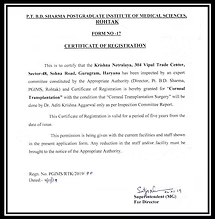
Choosing where to have a cornea transplant matters as much as the decision to have one. A few things set Krishna Netralaya apart for cornea care:
See an eye specialist promptly if you have ongoing blurred or cloudy vision, vision that keeps getting worse, a known cornea problem such as keratoconus or Fuchs’ dystrophy that is progressing, or pain and redness in an eye with a damaged cornea. The earlier a corneal problem is assessed, the more options you have, and in many cases a transplant can be avoided or planned calmly rather than as an emergency.
If you have already had a cornea transplant, contact your surgeon straight away if you notice the RSVP warning signs, Redness, Sensitivity to light, a drop in Vision, or Pain, as these need prompt attention.
No. The eye is fully numbed, so you do not feel pain during the operation. Afterwards most people feel only mild grittiness or discomfort, which is managed with eye drops and settles over a few days.
It is a well-established, routine eye operation, usually taking under an hour and often done as a day procedure. Only the damaged part of the cornea is replaced. Serious complications are uncommon, and most issues are treatable when caught early at follow-up.
Rejection is much less common than with organ transplants, because the cornea has no blood vessels. If it begins, it can usually be reversed with eye drops when treated early, which is why you are taught the warning signs and kept on follow-up.
Light daily activities resume within days, and desk work often within a couple of weeks. Full visual recovery is slower, taking months to a year or more, because the cornea heals slowly. Stitches may stay in for many months and are removed gradually.
Vision improves gradually over months rather than instantly. Most people regain clear, usable sight, but many still need glasses or a contact lens for their sharpest vision, because the new cornea rarely gives a perfectly even focus on its own.
There is no single best treatment, it depends on the type, cause, and severity. It may range from artificial tears and lifestyle changes to eyelid care, inflammation control, punctal plugs, or advanced in-clinic options. A proper assessment identifies the right approach.
Yes. Because a stable tear film is needed for clear sight, dry eye can cause blurred or fluctuating vision that usually clears when you blink. Treating the dry eye typically improves it.
Some evidence suggests omega-3 fatty acids may help certain people with dry eye, particularly the evaporative type. Discuss it with your eye specialist as part of an overall plan.
Age alone is rarely a barrier. Cornea transplants are done successfully in children and in older adults. Suitability depends on the health of the rest of the eye, which your surgeon checks before recommending surgery.
Yes. If a graft clouds over or stops working, a transplant can usually be repeated with fresh donor tissue. A failed graft is not the end of the road for the eye.
A cornea transplant commonly takes around 45 minutes to an hour, depending on the type. Many people go home the same day or after a short stay, and will need someone to drive them home.